
Questions to Ask When Choosing a Hospice Provider for a Loved One
Questions to ask when choosing a hospice provider can feel overwhelming, especially when you are making decisions for someone you love. Many families reach this point after a long journey of caregiving, medical decisions and emotional stress. It’s normal to feel unsure about what to ask, what matters most, or how to know if a hospice provider is the right fit.
Families we speak with at Sunset Hospice Inc often share that they worry about asking the “wrong” questions or not knowing where to begin at all. Asking thoughtful questions can help bring clarity during a difficult time. These question are not about finding “perfect” answers. They are tools to help you understand how a hospice provider approaches care, communication and support for both, your loved one and your family.
This guide is written to help you feel more prepared and confident as you talk with hospice providers, at your own pace and in your own way.
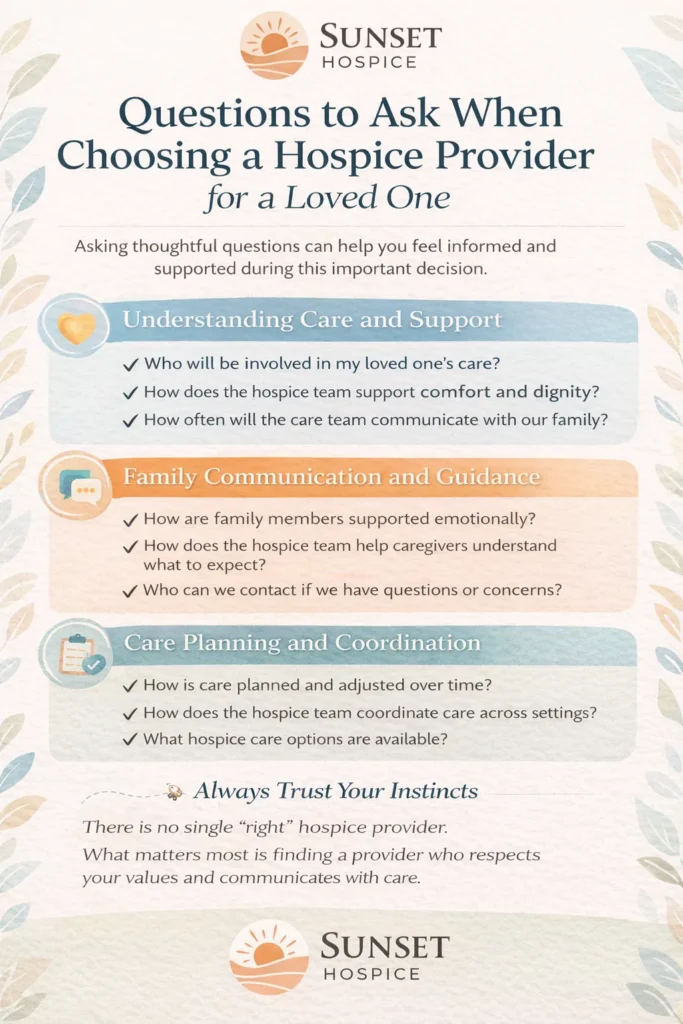
In Brief: Key Takeaways
- Asking questions can help families feel more grounded and informed
- Hospice care focuses on care, dignity and support for both patients and families
- Clear communication and compassionate care matter just as much as medical services
- There is no single “right” hospice provider, what matters is alignment with your values.
Why Asking the Right Questions Matters?
When families begin exploring hospice care, they are often carrying a great deal of emotional weight. Questions help create space for understanding during a time that may feel rushed or uncertain. Asking questions can help you understand how care is provided for the patient, clarify what support looks like for your family, learn how communication works, and feel more confident in conversations with care teams.
At Sunset Hospice, we believe these conversations should feel supported, not overwhelming. Hospice providers may offer similar services on paper, but their approach to care, communication and family involvement can feel very different in reality. Before speaking with any provider, it helps to have a solid foundation of what hospice actually involves. Our guide to Facts About Hospice Care for Families covers the full scope of hospice services, team roles and what families can expect from the start. Thoughtful questions help reveal those differences in a gentle and respectful way.
It’s okay if you don’t know exactly what to ask at first. Even a few open-ended questions can help start a meaningful dialogue and get you clearer sense of what to expect.
Questions About Care and Support
Understanding how care is delivered can help families feel reassured about their loved one’s comfort and dignity.
Who will be involved in my loved one’s care?
Hospice care is typically provided by an interdisciplinary team. This means different professionals work together to support physical comfort, emotional well-being and communication.
Families working with Sunset Hospice, for example, ask how each team member contributes and how everyone stays connected. This can help you understand how needs are addressed from different perspectives.
How does the hospice team support comfort and dignity?
Comfort is a central focus of hospice care. Asking how comfort needs are addressed and supported can help you understand the provider’s approach to care. Families often find it useful to read about Hospice Comfort Care beforehand so they know what to look for when a provider describes their comfort focused approach.
At Sunset Hospice, these conversations often focus on listening closely to patients and families and adjusting as care needs change. This question is less about medical details and more about philosophy and responsiveness.
How often will the care team communicate with our family?
Clear communication can ease anxiety and help families feel supported. You may want to ask how updates are shared, who your main point of contact will be, and how questions are handled. We always encourage families asking about hospice care in Cypress to raise communication expectations early so that nothing feels unclear when care begins.
Questions About Family Communication and Guidance
Hospice care supports not only the patient, but also the people who love them.
How are family members supported emotionally?
Many hospice providers offer emotional and spiritual support for families. This may include conversations with social workers, spiritual care providers or other members of the care team. We always encourage families to ask what support looks like during especially difficult moments and how to reach out when they need someone to talk.
How does the hospice help caregivers understand what to expect?
Caregiving can feel unfamiliar and intimidating, especially when families are unsure about what change may occur. Asking how guidance and education are provided can help caregivers feel less alone. Our teams at Sunset Hospice see education as an ongoing conversation, not a one-time discussion.
Who can we contact if we have questions or concerns?
Knowing who to reach out to – and when – can offer peace of mind. You may want to ask how after-hours questions are handled and what support looks like outside of scheduled hours.
Questions About Care Planning and Coordination
Care needs change over time, and families often want to understand how hospice providers respond to those changes.
How is care planned and adjusted over time?
Hospice care is not static. Asking how care plans are reviewed and updated can help you understand how the team responds as needs evolve. Care planning conversations are often revisited as families’ questions and priorities change.
One area that frequently shifts over time is symptom management, and knowing in advance how a provider handles this is worth exploring through our guide on Managing Common Symptoms in Hospice.
How does hospice team coordinate care across settings?
Hospice care may be provided in different settings depending on individual needs. Asking how care is coordinated can help clarify how continuity is maintained.
What hospice care options are available?
Understanding available options can help families feel more informed. You may want to ask what types of support are offered and how decisions are made collaboratively.
If you are still in the early stages of understanding what hospice involves versus other forms of supportive care, Palliative Care vs Hospice Care offers a clear side by side comparison that can sharpen the questions you bring to any provider conversation.
Frequently Asked Questions (FAQ)
Conclusion
Choosing a hospice provider is a deeply personal and emotional decision, and it’s okay if it takes time to feel comfortable. Asking thoughtful questions can help you feel more informed, supported and grounded as you move forward.
At Sunset Hospice Inc, we believe families deserve clear information, compassionate listening and space to make decisions that feel right for them. There is no single checklist that fits every situation – only conversations that help guide you with care and respect.
If you’re feeling unsure, remember that asking questions is not a burden. It’s an important part of caring for someone you love, and hospice teams are there to walk alongside you, one conversation at a time.